 Skip to content
Geopoetics
Plant Memory and Fictional Archaeology
2025-2026
Concept & Framework
Geopoetics: Plant Memory and Fictional Archaeology is a long-term, practice-based research project. It
approaches plants as objects of inquiry structured by a dual framework: on the visual level, plants appear
as recognizable and translatable sign forms; on the cultural level, they function as material carriers of
knowledge, experience, and geographic specificity. Through this duality, plants are not only objects of
natural representation, but also mediators through which cultural knowledge is formed and preserved.
In this project, “memory” does not simply refer to a mechanism for preserving the past, but rather
to a temporal-operational structure. On the one hand, memory acts as the psychic sedimentation of
past experience, forming a cultural layer that can be accumulated and transformed. On the other hand,
memory is also prospective: its mode of operation allows for the extrapolation and generation of future
cultural imaginaries, thereby positioning memory as a generative logic oriented toward future ruins.
Based on this understanding, the project adopts “fictional archaeology” as its methodological
framework. Unlike conventional archaeology, which excavates and classifies existing artifacts, fictional
archaeology situates contemporary materials and plant forms within a projected future archaeological
context, turning the act of creation itself into a process of artifact formation. Within this framework,
material is no longer passive evidence to be preserved; rather, through temporal projection and
reconstruction, it is pre-inscribed as a “possible history.” A series of relief-like paintings, resembling
stratigraphic slices, emerges as carriers of and fictions on symbolic knowledge systems associated with
specific plants, forming a cultural imaginary that connects past, present, and imagined futures.excavate
both personal and collective experience, making visible the relationship between material and memory,
and attempting to locate my own position within a constantly shifting world
Material Methodology & Practice
In practical terms, the process begins with the collection of morphological data and local knowledge
narratives related to specific plants, which are then translated into non-representational structural
sketches. These sketches are not intended for depiction, but serve as guides for material accumulation,
allowing the final forms to exist between recognition and estrangement, thus constituting “quasi
artifacts” that resist classification within existing taxonomic systems.
My practice operates between relief painting and sculpture, primarily constructing plant forms through
processes of material layering and accumulation. Plants are treated not as objects to be represented,
but as material structures to be constructed. Through the gradual buildup and shaping of plaster-like
substances, plant forms are not imprinted or reproduced, but instead emerge through the interaction
between material and the body, becoming relief-like material presences. This process transforms plants
from “natural outcomes” into “processes of artificial material construction.”
The project also takes “material painting” as a central methodological approach, employing substances
with inherent temporality and transformative potential, including calcium carbonate, soil, gravel, clay,
minerals, fossils, mother-of-pearl, and construction materials. These are layered through mixtures
with PVA and plaster. As these materials dry and settle, they form structures analogous to geological
cross-sections, rendering the pictorial surface a material record of time. However, this record does not
represent the past; rather, it operates as a constructive engagement with temporal rupture, accumulation,
and reconfiguration. These materials are selected not only for their physical properties, but also for their
embedded temporal scales: minerals and fossils correspond to geological time, soil carries ecological
cycles, and construction materials point to the historical layers of human activity. Their coexistence on a
single surface creates a site in which multiple temporalities converge
Perception & Context
As viewers approach the work, the image is initially perceived as a plant form. Yet at closer proximity,
the rough surface of mineral particles and layered structures becomes increasingly evident, shifting
perception from image recognition to an awareness of material temporality. The viewer’s gaze oscillates
between “identification” and “tactile imagination,” leading to the realization that these forms do not
represent nature, but are the result of accumulated time.
Building on this, the project also engages with the generative relationships between different systems of
knowledge. Institutional disciplines such as botany, archaeology, and geology provide stable frameworks
for classification and description, while practice-based knowledge—derived from farmers, artisans, and
gatherers in close interaction with the land—constitutes a more fluid system grounded in embodied
experience. These two forms of knowledge are not oppositional; rather, they overlap through everyday
practice and cultural sedimentation, forming a multi-layered cognitive landscape. However, they do not
always align seamlessly: institutional classification tends toward stability and standardization, whereas
experiential knowledge is situational and indeterminate. This project seeks to preserve these differences,
allowing the work to reveal visible traces of “distortion” and “displacement” within processes of
knowledge translation.
Through transregional residency experiences (Greece, Taiwan, Shanghai, Germany, and the United
Kingdom), the project incorporates diverse phytogeographic conditions and cultural interpretative
systems into its process, positioning residency not merely as a site of production, but as an experimental
space for knowledge exchange and temporal layering. In this context, each work functions as a
“prefabricated model of a future artifact,” continuously testing the translational relationships between
material, memory, and knowledge

Geopoetry - Switzerland - Edelweiss , 2026
Mixed media (mother-of-pearl, watercolor, acrylic, marble, soil, sand, plasters, clay and gold, silver, and copper foils) on canvas
120x180cm(47.24x70.86 in)

Geopoetry - Taiwan - Gentian , 2026
Mixed media (mother-of-pearl, watercolor, acrylic, marble, soil, sand, plasters, clay and gold, silver, and copper foils) on canvas
120x180cm(47.24x70.86 in)

Geopoetry - UK - Crocus , 2026
Mixed media (mother-of-pearl, watercolor, acrylic, marble, soil, sand, plasters, clay and gold, silver, and copper foils) on canvas
120x180cm(47.24x70.86 in)

Geopoetry - Shanghai - White Magnolia , 2026
Mixed media (mother-of-pearl, watercolor, acrylic, marble, soil, sand, plasters, clay and gold, silver, and copper foils) on canvas
120x180cm(47.24x70.86 in)

Temple of Mother Earth - Sunflower , 2025
Mixed media (watercolor, acrylic, soil, gravel,
calcium carbonate, marble, clay, chalkstone, PVA
resin, mother-of-pearl, ammonite fossil, gold, silver,
and copper foils ) on canvas base.
194x112cm

Geopoetry - Lotus , 2025
Mixed media (watercolor, acrylic, soil, gravel,
calcium carbonate, marble, clay, chalkstone, PVA
resin, mother-of-pearl, ammonite fossil)on canvas
90x90cm(35.43x35.43 in)

Geopoetry - Germany - Dandelions
Material : Mixed media (mother-of-pearl, watercolor, acrylic, flint fragments, soil, sand, plasters, clay and gold, silver, and copper foils) on canvas
Year : 2026
Size :30x30cm

Geopoetry - Germany - Marto Rose
Material : Mixed media (mother-of-pearl, watercolor, acrylic, flint fragments, soil, sand, plasters, clay and gold, silver, and copper foils) on canvas
Year : 2026
Size :30x30cm

Geopoetry - Germany - Drooping Star-of-Bethlehem
Material : Mixed media (mother-of-pearl, watercolor, acrylic, flint fragments, soil, sand, plasters, clay and gold, silver, and copper foils) on canvas
Year : 2026
Size :30x30cm

Geopoetry - Germany - Lithodora Diffusa
Material : Mixed media (mother-of-pearl, watercolor, acrylic, flint fragments, soil, sand, plasters, clay and gold, silver, and copper foils) on canvas
Year : 2026
Size :30x30cm

Geopoetry - Germany - White Dame's Violet
Material : Mixed media (mother-of-pearl, watercolor, acrylic, flint fragments, soil, sand, plasters, clay and gold, silver, and copper foils) on canvas
Year : 2026
Size :30x30cm

Geopoetry - Germany - Crocus
Material : Mixed media (mother-of-pearl, watercolor, acrylic, flint fragments, soil, sand, plasters, clay and gold, silver, and copper foils) on canvas
Year : 2026
Size :30x30cm

Geopoetry - Germany - Edelweiss
Material : Mixed media (mother-of-pearl, watercolor, acrylic, flint fragments, soil, sand, plasters, clay and gold, silver, and copper foils) on canvas
Year : 2026
Size :20x20cm

Geopoetry - Germany - Drooping Star-of-Bethlehem
Material : Mixed media (mother-of-pearl, watercolor, acrylic, flint fragments, soil, sand, plasters, clay and gold, silver, and copper foils) on canvas
Year : 2026
Size :20x20cm

Geopoetry - Edelweiss, Forget-me-not, Red Poppy , 2025
Mixed media (watercolor, acrylic, soil, gravel, calcium carbonate, marble, clay, chalkstone, PVA resin, mother-of-pearl) on canvas
)
145.5x97cm(57.48x38.18 in)

Geopoetry - Naxos (Olive)
Material : Mixed media (mother-of-pearl, acrylic, marble, plasters and clay) on canvas
Year : 2025
Size : 120X90 cm
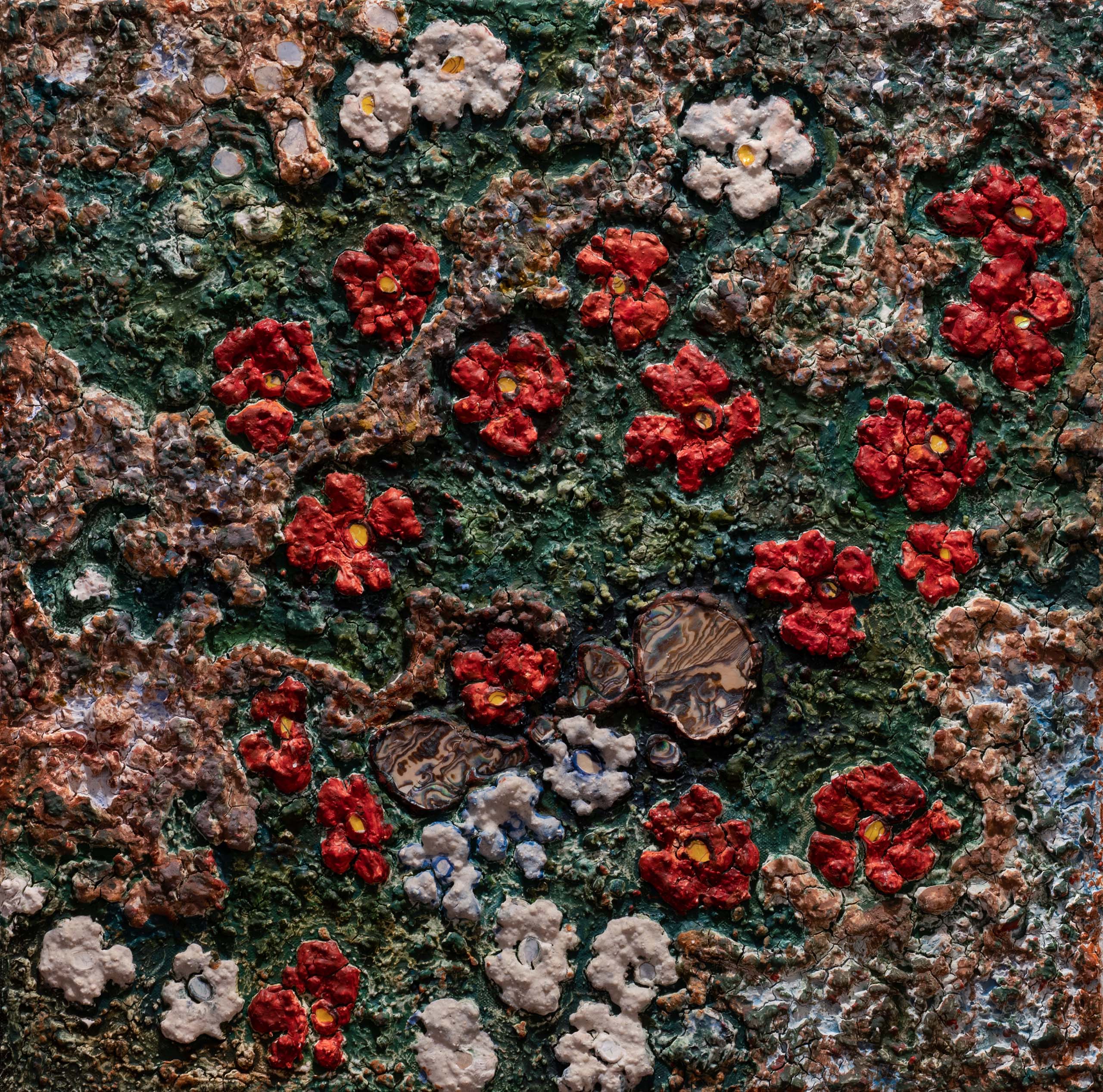
Geopoetry - Naxos (Red Poppy)
Material : Mixed media (mother-of-pearl, acrylic, chalk, plasters, marble and clay) on canvas
Year : 2025
Size : 35x35cm
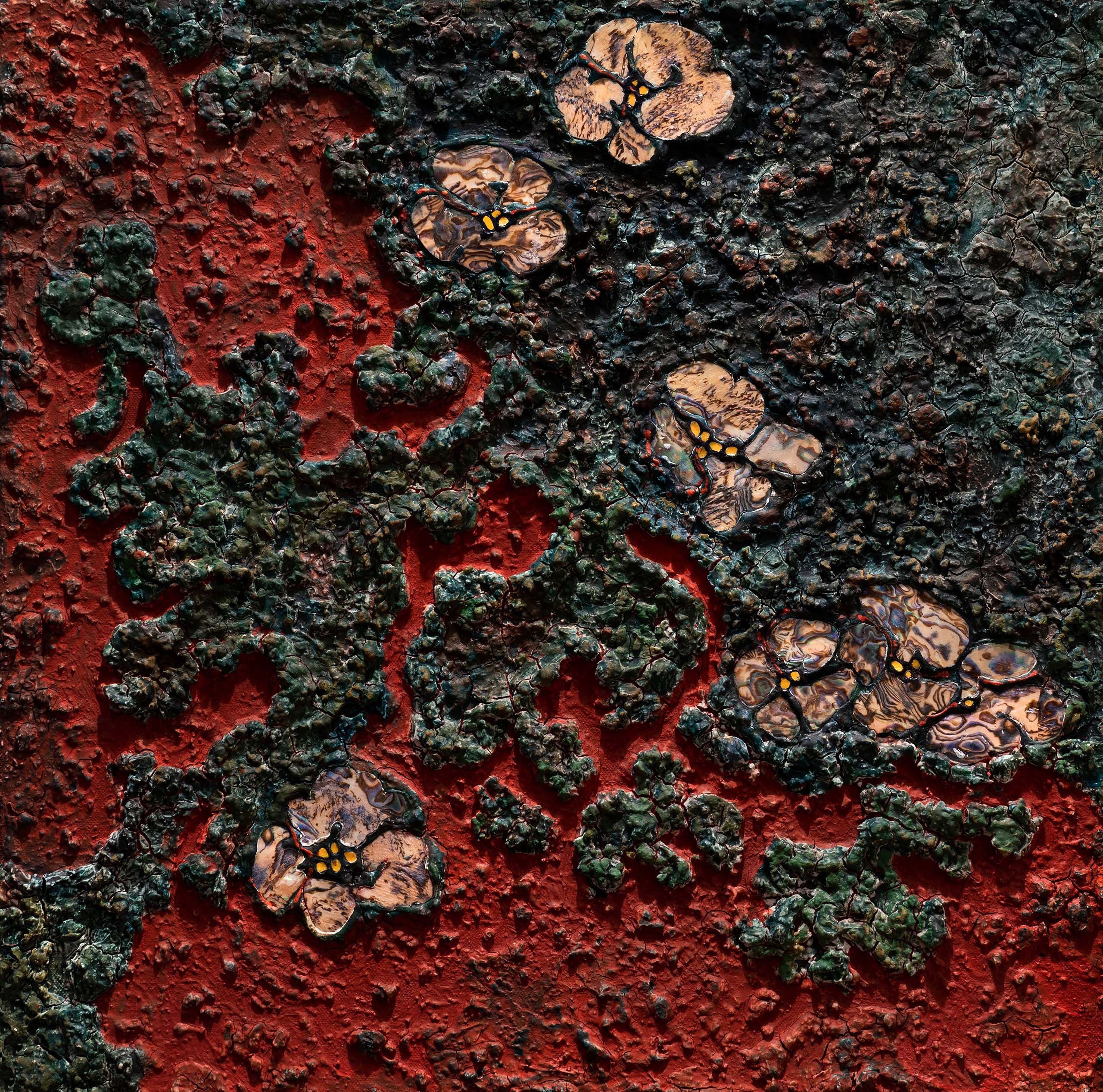
Geopoetry - Aegean Sea (Saffron)
Material : Mixed media (mother-of-pearl, acrylic, chalk, plasters, marble and clay) on canvas
Year : 2025
Size : 35x35cm

Geopoetry - Naxos (Greek chamomile)
Material : Mixed media (mother-of-pearl, acrylic, chalk, plasters, marble and clay) on canvass
Year : 2025
Size : 70x50cm

Geopoetry - Aegean Sea (Papyrus)
Material : Mixed media (mother-of-pearl, acrylic, ammonite fossil, plasters, marble and clay) on canvas
Year : 2025
Size : 30X20cm

Geopoetry - sunflower
Material : Mixed media (mother-of-pearl, ammonite fossil, acrylic, chalk, plasters and clay) on canvas
Year : 2025
Size : 35x35cm
